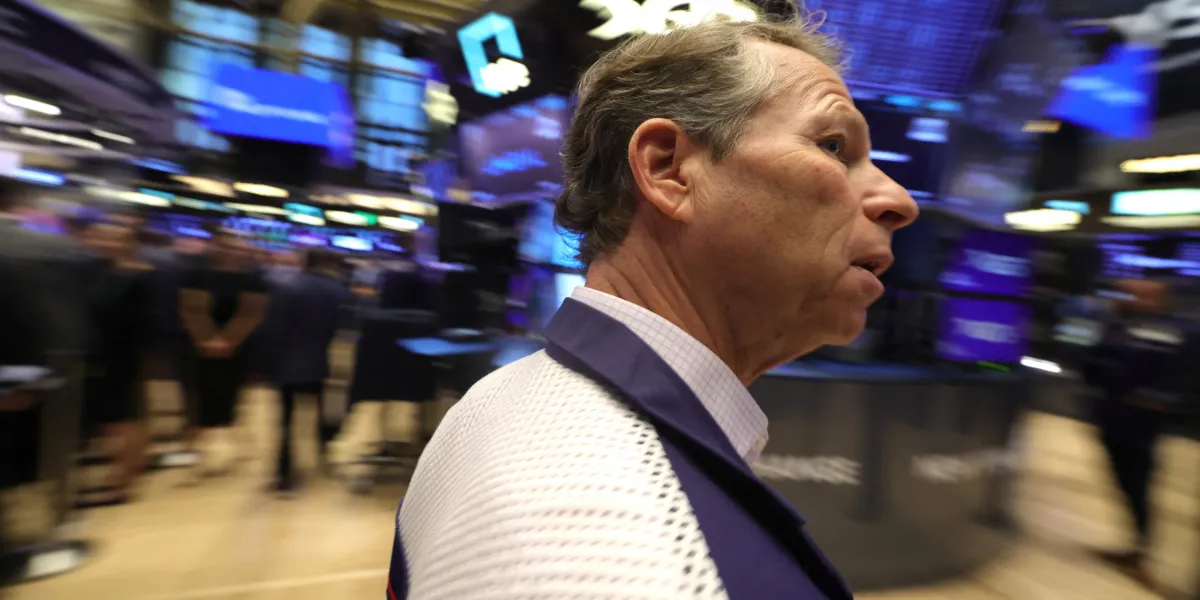
Gold hits new record and stock futures tumble as Wall Street worries over Trump’s tariff price increases
Gold hits new record and stock futures tumble as Wall Street worries over Trump’s tariff price increases
Jim Edwards is the executive editor for global news at Fortune. He was previously the editor-in-chief of Business Insider's news division and the founding editor of Business Insider UK. His investigative journalism has changed the law in two U.S. federal districts and two states. The U.S. Supreme Court cited his work on the death penalty in the concurrence to Baze v. Rees, the ruling on whether lethal injection is cruel or unusual. He also won the Neal award for an investigation of bribes and kickbacks on Madison Avenue.
S&P 500 futures are down -0.51% this morning and futures on the Nasdaq 100 are down even more, -066%. Dow Jones futures were down -0.37%. The U.S. markets have had a three-day weekend so it’s difficult to say exactly why investors seem so skittish.
Top of the list of usual suspects is, of course, “uncertainty.” An appeals court threw out President Trump’s tariff plan last week, which the markets had finally priced-in after months of uncertainty. More uncertainty lies ahead as the U.S. Supreme Court takes the case.
And then there is Trump’s war against the Fed, in which his allies have asked the Department of Justice to conduct criminal probes of both Chairman Jerome Powell and Governor Lisa Cook. Investors are unenthusiastic about the idea of a politically driven U.S. Federal Reserve because it leads to more—you guessed it—uncertainty.
Deutsche Bank’s George Saravelos says investors have yet to move on that issue, however: “How much loss of independence is the market pricing? Surprisingly little, from our perspective,” he told clients this morning. “Long-term inflation expectations are the definitional metric of an independent central bank and these have barely moved in recent weeks. Or perhaps the market believes that even though President Trump is increasing his influence over the Fed, he remains committed to keeping inflation low even at the cost of weaker growth … To sum up, the market is currently not pricing any long-term shift in the Fed’s reaction function around inflation.”
Perhaps investors are looking at the soft data, which is signalling that tariff-driven price increases are finally being passed down to consumers, and that while consumer spending has been robust recently, they may be running out of gas.
“80% of firms reported that they were passing cost increases from tariffs on to consumers,” Goldman Sachs told clients this morning. The bank’s research was based on the Dallas Fed’s surveys of companies. “Among those respondents, 21% reported that they have already passed through the full cost of the tariffs to customers,” Jessica Rindels and her team wrote.
The consumer isn’t in good shape to deal with those price increases, according to Samuel Tombs of Pantheon Macroeconomics.
“Real consumption rose
Discretionary retail sales look like they rose in August, Tombs says, which would normally be positive news—except that growth in consumers’ after-tax income has fallen to near zero.
“The foundations for a renewed pick-up in households’ real spending are lacking. Real after-tax income rose
It’s not clear that these macro concerns are behind investors’ pessimism this morning. But it is clear that investors are pessimistic: The price of gold—usually regarded as a safe haven for nervous traders—hit another record high today. The Comex continuous contract for gold was at $3,551.80, up 1% on the day.
Here’s a snapshot of the markets globally this morning:
About the Author

Claire Dubois
View all articlesComments (0)
No Comments Yet
Be the first to share your thoughts on this article!