Russian Low-Cost Drones Are Changing the Face of Its War in Ukraine
Russian Low-Cost Drones Are Changing the Face of Its War in Ukraine
Aerial encirclement
In Ukraine’s Donbas, a Vital Highway Under Siege — And the Soldiers Trying to Shield It
‘Not a one-sided game’
Have Ukrainian Drones Really Knocked Out 38% of Russia’s Oil Refining Capacity?
Russia scales up
Sign up for our free weekly newsletter
Remind me next month
KHERSON REGION, Ukraine — At in the morning, our car pulls onto the M-14 highway linking Mykolaiv and Kherson.
“We’re lucky today,” says my guide, local
The M-14 is now Kherson’s only reliable connection with the rest of Ukraine. This critical supply line has been within the range of Russian drones since mid-July — but alternative routes are even more exposed to artillery and drone (UAV) attacks.
“For Kherson, this is a serious logistical challenge,” Horevaya explains. “All supplies — food, humanitarian aid, medicine — everything passes along this road. This includes passenger transport. ... If this road comes under heavier fire, things could get desperate.”
The widespread use of first-person-view (FPV) drones, cheap devices assembled from off-the-shelf components, has transformed modern warfare since Russia’s full-scale invasion of Ukraine.
Both sides have adopted the technology on a massive scale since 2023, and it has continued to evolve at breakneck speed.
As the destructive power of explosive payloads grows and electronic warfare systems adapt in response, the single most consequential shift on the battlefield has been in flight range.
The so-called “kill zone,” once limited to five or 10 kilometers, now extends as far as 20 and in some cases even 30 or 40 kilometers.
This development has had far-reaching consequences. In recent months, Ukraine’s rear areas have come under intensified attack from Russian drone units.
Since July, Russian forces have succeeded in partially disrupting supply routes to Kherson — the main Ukrainian stronghold in the south — as civilian cars and supply trucks have come under systematic FPV strikes.
Our journey along the M-14 was carefully timed: the threat of attacks is higher after nightfall.
The Ukrainians, however, have adapted. Sections of the highway are now protected
The most effective protection remains electronic warfare and anti-drone defense units stationed along the route. Their presence has sharply reduced the number of vehicles destroyed. Yet it remains impossible to shield the entire length of the highway, and Russian drones continue to exploit the gaps.
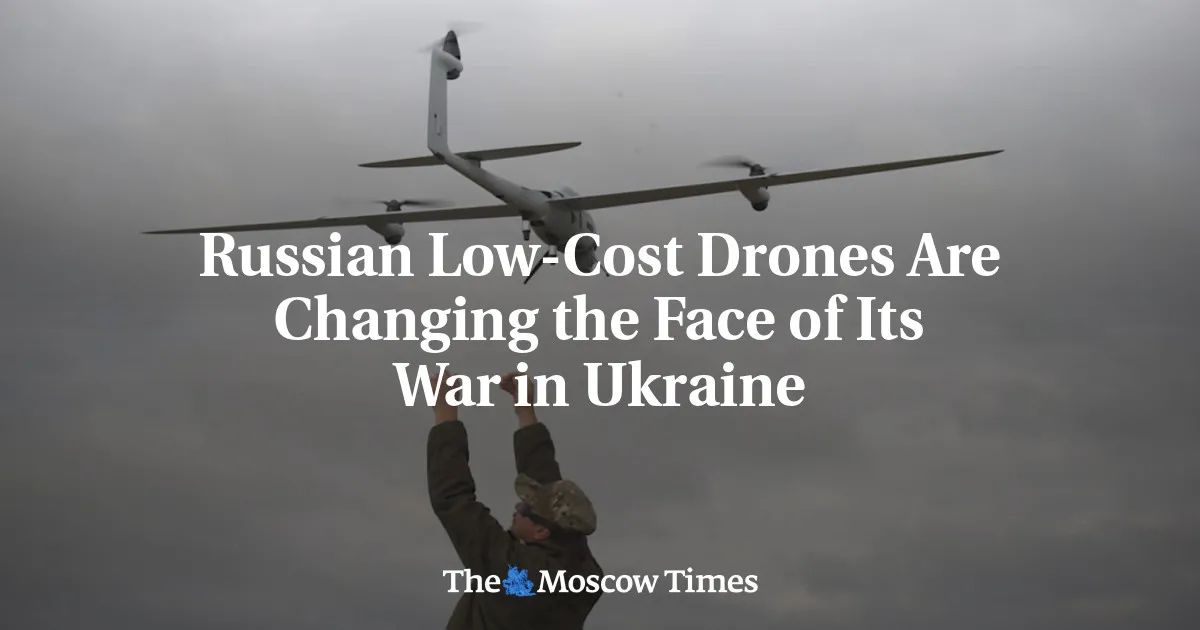
Part of the challenge lies in Russia’s own technological adaptation. In 2024, Moscow began using the Molniya, a new fixed-wing UAV built from simple materials like plywood and aluminium.
Despite its rudimentary design, it has proved to be a precise and formidable weapon capable of striking targets more than 30 kilometers away.
These drones are now being used intensively in the Kherson region.
"These Molniyas have been spotted for a couple of days,” Horevaya said. “They are increasing their flight range and are starting to strike at places where the usual FPVs cannot reach, closer to the border between the Kherson and Mykolaiv regions. This, of course, complicates the fight against them.”
Russian forces employ several methods to launch FPV drones.
Some are deployed from “motherships” — large multi-rotor hexacopters or octocopters that act as airborne launch platforms.
Others are carried
Russian forces have also occasionally used fiber-optic-controlled drones immune to radio interference.
However, the Molniya and the drone motherships can act both as carriers and as relays which significantly extends the range of radio-controlled FPV drones, explains Ukrainian military analyst Oleksandr Kovalenko.
“This allows FPV drones to be released 30 to 40 kilometers from the front line and used to hunt vehicles, personnel or fixed targets,” he said.
According to Kovalenko, drone motherships are proving particularly effective, extending both flight time and range.
This helps explain the surge in Russian attacks on Ukrainian supply lines in the south and east. Near the M03 highway linking Donetsk and Kharkiv, Russian troops have advanced in the Lyman district, bringing their lines closer to one of Ukraine’s main logistical arteries in the Donbas.
“As the front line moves closer to us, so do their drone operators,” says Yevhenii, a Ukrainian soldier specializing in UAV operations who spoke on condition of anonymity. “The drone mothership can also fly much deeper into our territory.”
Ukraine’s own drone units, however, are responding in kind.
“We use the same gaps as the Russians — we fly dozens of kilometers into their lines, too. It’s definitely not a one-sided game,” Yevhenii says.
Kyiv has also developed interceptor drones capable of shooting down enemy UAVs, as well as its own motherships and fixed-wing Molniya variants. These technologies have been effective enough for Russia to start developing similar systems.
Kovalenko describes such methods as “active defense” — eliminating drone launch platforms and operators before they strike.
“In addition to shooting down drones when possible, hitting their launch sites is an effective means of active defense. Hunting down drone operators and reducing their numbers is very important," he says.
On the eastern front, the balance of forces varies widely.
“Our Russian counterparts are just as skilled as we are,” says Yevhenii, “but they have far greater numbers and re
The disparity is stark in the Dnipropetrovsk region, where he is deployed.
“As my senior comrade said, it's a bloodbath. When the weather is good, both sides fly constantly. But if an enemy reconnaissance drone appears, we might send one interceptor. They send three or four kamikaze drones at once.”
Kovalenko argues that this imbalance is localized to that section of the front, where the Russians have concentrated four combined-arms armies plus an army corps with motorized rifle regiments and reserves — about 100,000 troops.
“We have far fewer personnel in this area,” he says. “It’s a very problematic area for us.”
Ukraine, grappling with chronic manpower shortages, has focused on developing unmanned systems to save soldiers’ lives.
Though Kyiv still has an edge in drone use, Russia is catching up fast.
“In March and April 2024, they were using about 250 FPV drones per day. Now they’re launching 1,000 to 1,200 per day — sometimes even more,” says Kovalenko. “In August, they set a record: around 30,000 FPVs used in a single month. That’s five or six times more than a year earlier.”
Russia can launch anywhere from 4,500 to 8,000 FPV drones per week, often depending on weather or supply constraints.
Moscow remains heavily reliant on Chinese imports of dual-use goods, Kovalenko noted, including both finished drones and spare parts.
In August, Ukrainian engineer and communications specialist Serhiy “Flash” Beskrestnov reported that footage recovered from a downed Russian Gerbera strike drone contained video files from a Chinese factory’s camera tests.
Its interface suggested that the drone could use “machine vision” to automatically identify vehicles — a sign of rapidly advancing automation.
Kovalenko notes that the Russians do not have sufficient capacity to produce drones without Chinese support. But while Ukraine initially used FPV drones to offset its manpower disadvantage, Moscow’s accelerated production could soon erase that edge.
“If the current trend continues, Russia could reach parity with our troops in FPV drone use
A Message from The Moscow Times:
Dear readers,
We are facing unprecedented challenges. Russia's Prosecutor General's Office has designated The Moscow Times as an "undesirable" organization, criminalizing our work and putting our
These actions are direct attempts to silence independent journalism in Russia. The
We, the
Your support, no matter how small, makes a world of difference. If you can, please support us monthly starting from just $2. It's quick to set up, and every contribution makes a significant impact.
About the Author

Anna Petrova
View all articlesComments (0)
No Comments Yet
Be the first to share your thoughts on this article!