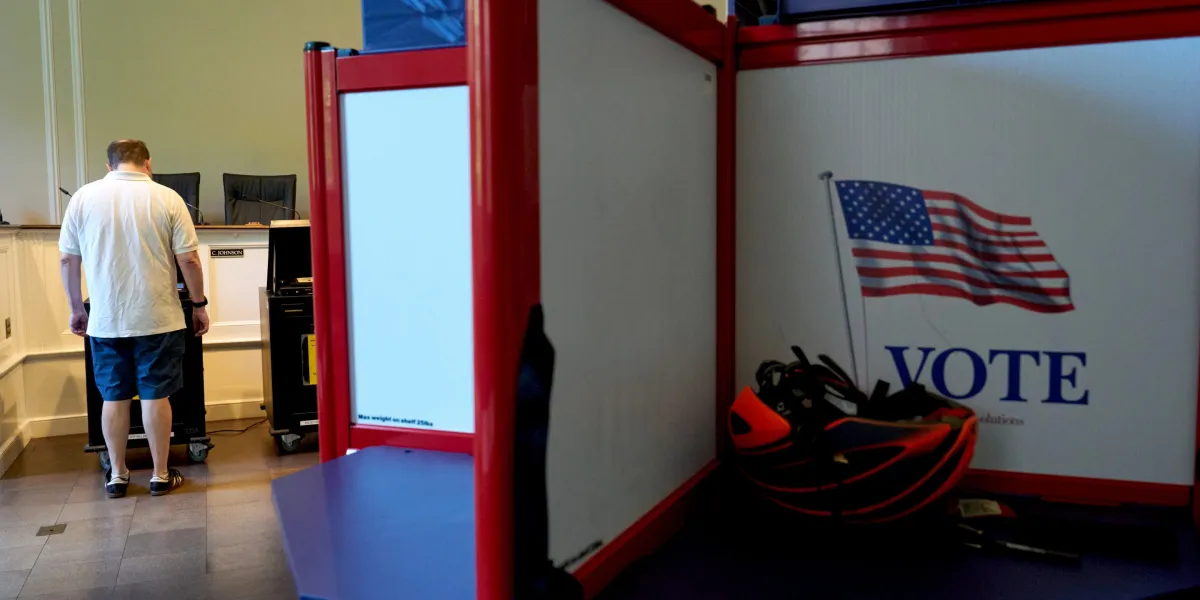
With Wall Street on edge about Friday’s jobs report, new data confirms the economy has the fewest job openings in nearly a year
With Wall Street on edge about Friday’s jobs report, new data confirms the economy has the fewest job openings in nearly a year
Markets eye Friday’s jobs data
Fed policy and economic outlook
Nick Lichtenberg is Fortune Intelligence editor and was formerly Fortune's executive editor of global news.
With Wall Street on edge about Friday’s jobs report for August—the first since July’s shocker, which included a massive downwards revision of jobs growth for May and June—it got another jolt on Wednesday. The JOLTS survey, a closely watched indicator of job openings and quits, confirmed the U.S. economy now has the fewest job openings in nearly a year, a clear sign that hiring momentum continues to cool.
Job openings for July noticeably slid to 7.18 million, down from June’s (revised downward) 7.36 million and sharply lower than consensus expectations. The openings rate also edged down to 4.3% as businesses scale back recruiting amid growing economic uncertainty. The most impacted industries include health care, arts and recreation, and mining, while regional drops were led
This weaker JOLTS report comes as investors brace for the monthly employment update, a critical catalyst in setting the tone for Federal Reserve policy and market sentiment. Earlier on Wednesday, Bank of America Research analysts warned the U.S. labor market was slowing due to supply-side factors including immigration restrictions, which have dampened the pace of hiring and lifted unemployment slightly since earlier this year.
Stocks fell on Tuesday to open trading for the month of September, after the Labor Day holiday, followed
In its global economic outlook, BofA continued to project a “mild stagflationary” environment in the U.S. for the remainder of 2025, with labor-market softness mostly reflecting supply shocks rather than collapsing demand. “The U.S. labor market is slowing down,” the bank said, “even though we think it is driven mostly
Recent payroll revisions and slower jobs growth suggest the market is muddling through, according to BofA, with average monthly job gains below the pre-pandemic trend. BofA forecasts the unemployment rate will edge higher through year end, running between 4.2%–4.4% in the coming quarters, and cautions that the labor sector remains the key economic risk. In other words, JOLTS just added significant weight to a crucial part of BofA’s thesis.
The July JOLTS slowdown reinforces BofA’s warning that the Federal Reserve is exposed to a possible policy error if it cuts rates too soon, given persisting inflation and a stalling labor market. Policymakers now face a difficult balancing act as supply-driven constraints lower the breakeven pace for job growth, amplifying the risk that Friday’s jobs report could drive financial volatility and a shift in monetary policy expectations. Separately, BofA warned it’s rare for the Fed to cut rates against a backdrop of rising inflation, and the last time it did so was shortly before the Great Financial Crisis of 2008.
Apollo Global Management chief economist Torsten Sløk speculated earlier in the week that the economy could be headed for an “inflation mountain” that recalls the inflation spike of the early 1980s. On Wednesday, ahead of the JOLTS report, Sløk surveyed several economic indicators and concluded that they’re suggesting “the labor market will continue to weaken.” He noted the current reading of small businesses saying they are experiencing poor sales suggests the unemployment rate could rise in coming months, while poor consumer sentiment about the labor-market outlook also suggests slowing job growth. He said this historical relationship would suggest Friday’s jobs report could come in lower than the 90,000 expected
In short, July’s JOLTS confirms the slowest labor market in some time—exactly as BofA predicted—while markets nervously await the next key jobs figures to see if this cooling trend continues.
For this story, Fortune used generative AI to help with an initial draft. An editor verified the accuracy of the information before publishing.
About the Author

Claire Dubois
View all articlesComments (0)
No Comments Yet
Be the first to share your thoughts on this article!